Smurf Dance: How to Do the 1980s Hip-Hop Move
TL;DR
- The Smurf dance is an early 1980s street and social dance that became part of hip-hop dance vocabulary.
- This tutorial follows Buddha Stretch’s version: a grounded down groove with relaxed, alternating arm movement.
- Learn the beat and knee groove first. Add one arm, then alternate the arms without losing the rhythm.
- The move can look different across regions and communities. Those differences do not make one version the only correct Smurf.
- I learned a traveling version from my sixth-grade friend Phom Bandy in 1984. I include it here for history and comparison, not as the main tutorial.
The Smurf dance is a hip-hop social dance recognized by its steady groove and alternating arm action. In the version Buddha Stretch demonstrates, the dancer stays mostly in place, keeps the knees bent, and lets the arms move loosely with the beat.
This page teaches Buddha Stretch’s version. My own childhood version traveled from side to side with a crossing step, so I explain that difference later. Hip-hop dances often change as they move through neighborhoods, schools, and generations.
What is the Smurf dance?
The Smurf is an early 1980s street and social dance that was later incorporated into hip-hop dance. Buddha Stretch gives that description at the beginning of the demonstration below.
The version shown here uses a continuous down groove through the knees and body. The arms stay relaxed and bent as they alternate. It should feel connected to the music, not like a set of isolated arm exercises.
The exact shape is not universal. Some dancers use a larger arm path, some keep it compact, and some communities know a traveling version. Learn the version in front of you while leaving room for other dancers’ experiences.
If you are new to this style, browse the hip-hop dance moves collection for more foundational party dances.
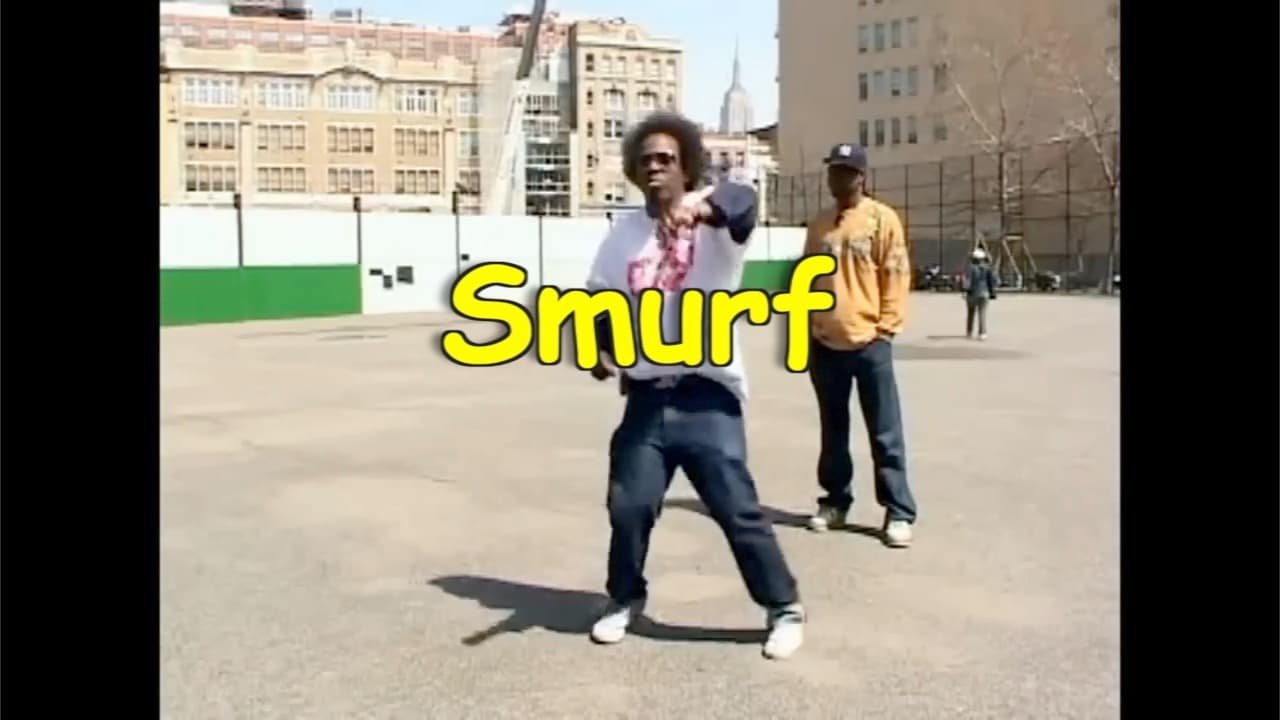
Watch Buddha Stretch demonstrate the Smurf
In this clip, Buddha Stretch demonstrates the Smurf he knows. Watch his bent knees, the down groove running through his body, and the loose arm action. The movement continues rather than stopping in a pose on each count.
I studied house dance history and technique with Buddha Stretch. I respect the knowledge he brings to this demonstration, while also recognizing that the version I knew as a child looked different.
How do you do the Smurf dance?
To do Buddha Stretch’s version of the Smurf dance, begin with a grounded down groove and add loose, alternating arm movement without losing the beat.
1. Start in a relaxed stance
Place your feet at a comfortable distance apart. Keep your knees soft and slightly bent. Let your shoulders and elbows relax.
Avoid standing tall with locked knees. The groove needs room to travel through your body.
2. Build the down groove
Bend down slightly on each beat: 1, 2, 3, 4. Let the knees create the motion while the torso follows naturally.
Do not chase a deep squat or maximum bounce height. Use a small level change that you can repeat without tensing your body.
3. Add one arm
Keep the elbow bent and let one arm travel loosely across and around the front of your body. The shoulder, elbow, and hand should feel connected rather than rigid.
Continue the knee groove while you practice this one arm. If the beat disappears, remove the arm and return to the knees.
4. Alternate the arms
Let the other arm take over as the first arm finishes its path. Keep alternating from one side to the other.
The hands do not need to trace a perfect circle. Focus on the relaxed exchange between the arms and the steady groove underneath them.
5. Connect the upper body
Allow the shoulders and torso to respond to the arm action. Keep the movement loose, rhythmic, and continuous.
The goal is not to copy a frozen shape. Match the relationship you see in Buddha Stretch’s demonstration: bent knees, moving body, and alternating arms working together.
How do you count and practice the Smurf dance steps?
Start by giving each beat one down accent:
1, 2, 3, 4
Keep that count steady through these layers:
- Groove through the knees without using the arms.
- Add one arm while keeping the same count.
- Practice the other arm by itself.
- Alternate the arms without changing your speed.
- Add more shoulder and torso movement only after the rhythm feels dependable.
This rhythm-first order keeps the step from becoming a piece of arm choreography with no groove. If staying on beat is difficult, use the Beat First method before adding more detail.
Why can the Smurf dance move look different?
Hip-hop social dances spread person to person. A move can change as it travels through different neighborhoods, schools, regions, and generations. The name may stay the same even when the steps do not look identical.
I saw that firsthand in the San Francisco Bay Area. In 1984, when I was in sixth grade, my best friend Phom Bandy showed me the move that the kids at our school called the Smurf. He was another sixth grader, not a dance historian, so he did not give me an origin story. He simply showed me the dance we knew by that name.
Our Smurf traveled sideways on four counts:
- Step the right foot to the right.
- Cross the left foot behind the right.
- Step the right foot to the right again.
- Bring the left foot close to the right foot.
Then repeat the pattern to the left. The upper body rocks in the same direction you are traveling.
Years later, I heard aerobics instructors call that side, cross-behind, side, together pattern a “grapevine.” That is where I learned the term grapevine. I am not saying the Smurf came from aerobics or that the two dances are the same.
Without the upper-body rock, my childhood version can look like an aerobics grapevine. When I teach it, I first have students rock the body side to side without moving the legs. Then we add the traveling foot pattern. The rock is what helps the step feel funky instead of looking like an exercise.
Compare it with an aerobics grapevine: Watch this grapevine demonstration. The foot pattern looks similar, but the demonstration does not teach the Smurf. It shows why the upper-body rock matters in the traveling version I learned.
That traveling version is included as personal history and comparison. The main Smurf dance tutorial on this page follows Buddha Stretch’s version.
Where did the Smurf dance come from?
The available evidence places the name in early 1980s dance culture, but it does not establish one verified inventor or one universal first version.
In the video, Buddha Stretch describes the Smurf as an early 1980s street and social dance that was incorporated into hip-hop later in the decade. His statement is a practitioner account from someone who participated in New York hip-hop dance culture.
The name was already present in music by late 1982. Tyrone Brunson’s single “The Smurf” first appeared on the UK chart on December 25, 1982. That date shows the name circulating by then, but it does not prove that the song created the dance.
A 1983 hip-hop guide by Dave Rimmer, preserved by TeachRock, listed the Smurf and said it was named after the cartoon characters. This is useful as a description published during the dance’s early period. It is not proof of who invented the movement or why every community used the name.
Dance scholar Imani Kai Johnson also includes the Smurf among hip-hop social dances in “A Historical Overview of Hip Hop Dance.” Taken together, these sources support the Smurf’s place in hip-hop dance history while leaving room for regional variation and incomplete documentation.
I have not found reliable evidence that the Smurf evolved from the Frug or from a dance on The Andy Griffith Show. Rather than repeat that story as fact, it is more accurate to separate documented sources from unverified claims.
Common Smurf dance mistakes
| What happens | What to change |
|---|---|
| The arms are stiff or locked straight | Relax the shoulders and keep the elbows bent. Let the arms travel instead of forcing a rigid shape. |
| The knees are locked | Use a small down groove on every beat. You do not need to bounce as deeply as possible. |
| Only the arms move | Practice the knees first, then let the shoulders and torso join the rhythm. |
| The timing changes when the arms start | Remove the arms, recover 1, 2, 3, 4, and add one arm at a time. |
| A variation is treated as the only correct Smurf | Name the version you are teaching and recognize that other communities may use the same name differently. |
| The traveling version looks like aerobics | Practice the side-to-side upper-body rock before adding the crossing steps. |
A simple practice progression
Practice the move in short rounds:
- Count and groove through the knees for four bars.
- Use one arm for four bars.
- Switch to the other arm for four bars.
- Alternate the arms for four bars.
- Put on music and keep the movement going without stopping to correct every count.
Once the rhythm feels steady, change the size and energy of the movement while keeping its foundation. Stay within a comfortable range, and stop if you feel pain or discomfort.
Keep learning hip-hop party dances
- Cabbage Patch dance: build a grounded groove with a different circular arm pattern.
- Roger Rabbit dance: practice another rhythmic party dance with coordinated arms and legs.
- Steve Martin dance: learn another move from 1980s hip-hop party-dance vocabulary.
- Private dance lessons: get direct help with timing, groove, and movement quality.
More Hip-Hop articles
Train 1-on-1 with Ceech.
Get personalized coaching tailored to your style and goals.
Book a Free Consult